Most brand owners do not get into ecommerce to get into logistics. They get into it to build a product, find an audience, and grow. Fulfillment is the part nobody plans for, right up until it becomes the part that eats every weekend.
If you run a growing ecommerce brand, you have probably felt the shift. Packing orders from your apartment or a small unit was fine at first. Then the volume crept up, the boxes took over the room, and the hour or two a day turned into most of your day. At some point the question stops being "how do I keep up" and becomes "should I still be doing this myself."
This is one of the first real operational decisions a brand faces, and it deserves a clearer answer than "it depends." So here is how we think about it, after running fulfillment for brands on both sides of the line.
How many orders before you need a 3PL?
As a rule of thumb, most brands should self-fulfill until they reach roughly 400 to 500 orders a month. Below that, the volume is manageable and the cost of outsourcing rarely justifies itself. You keep cash lean and you stay close to your customer.
More importantly, that early stretch is where you learn how fulfillment actually works. Packing your own orders teaches you your product, your packaging, your shipping options, and every step in between. That knowledge is not wasted when you eventually hand fulfillment off. It is exactly what lets you choose the right 3PL and hold them accountable, because you are not trusting them at their word. You know how the process works, so you know what good looks like and you can tell when you are getting it. A brand owner who has never fulfilled an order is far easier to take advantage of than one who has done it themselves. We think starting in-house is not just acceptable, it is the right way to begin.
Once you cross 400 to 500 orders a month, the math changes. At that volume, packing every order yourself stops being a reasonable use of your time. It is not always that the work is impossible. It is that every hour spent taping boxes is an hour not spent on marketing, design, sourcing, and the things that actually grow the brand.
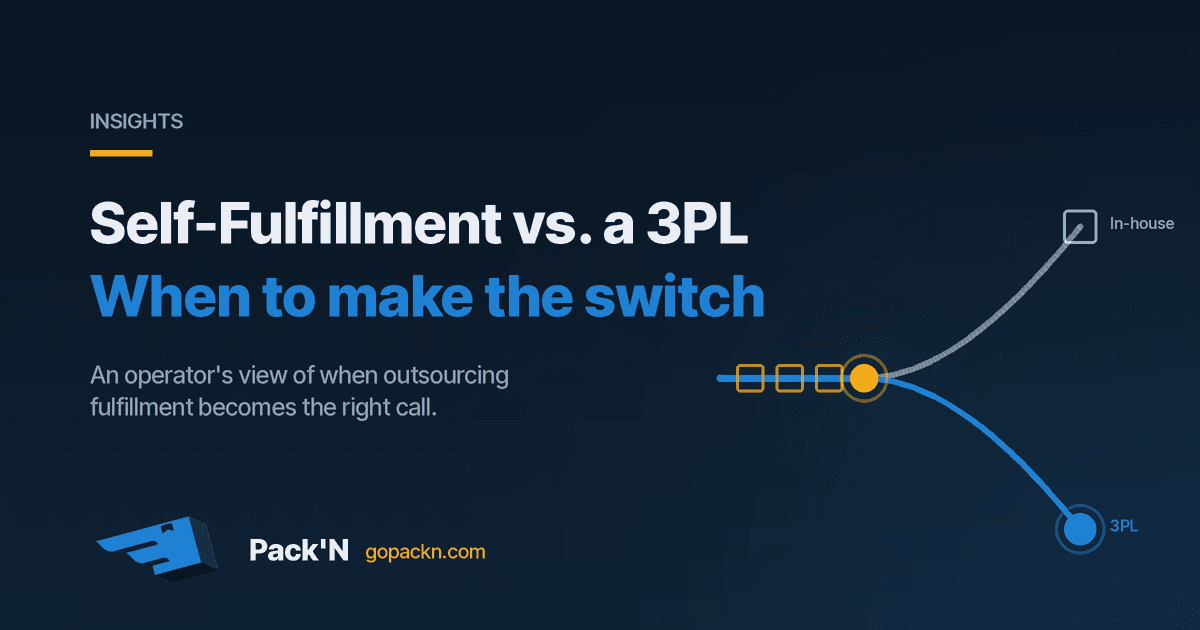
That is the fork in the road. You either scale fulfillment in-house, which means building your own operation, or you hand it to a third-party logistics partner (a 3PL). Both are valid. They just suit very different brands.
These numbers shift with your product. A brand shipping small, light, fast-moving items hits the wall later than one shipping bulky goods with slow inventory turnover. Treat the breakpoints as operator judgment, not law.
Option A: scaling fulfillment in-house
Bringing fulfillment in-house gives you something real: control. You see exactly what is happening, you set the quality bar, and you own the customer experience end to end. For some brands, that control is worth a great deal.
But here is the part that catches owners off guard. Once you scale a self-fulfillment operation, you are no longer just running a brand. You are running a second business whose entire job is to move boxes.
That second business comes with everything a business comes with. Insurance. Employees. Hiring, HR, and payroll. A warehouse management system. Carrier accounts and rate negotiation. Claims when shipments are lost or damaged. Inbound receiving and supply management. None of this is glamorous, and all of it pulls on the same finite attention you should be spending on the brand.
And then there is the part almost nobody factors in: returns.
Returns are a whole second operation
If you self-fulfill, you do not just ship orders out. You also have to take them back. Returns are their own discipline, and in apparel especially, where sizing and try-on drive return rates up, they are not a footnote. Every return has to be received, inspected, graded for condition, and then either restocked into sellable inventory or written off. Then the refund or exchange has to be processed, and the customer side handled.
That is a reverse supply chain running alongside your outbound one. It has its own labor, its own space, and its own software. When people say in-house fulfillment is a second business, the honest version is that it is a second business with two divisions: getting orders out, and getting returns back in. A capable 3PL absorbs both, which is why we treat reverse logistics as core, not an add-on.
The scaling trap
The economics of in-house fulfillment are heaviest where you can least afford them: fixed cost.
A self-fulfillment operation carries high fixed costs whether you ship 500 orders or 5,000. Rent, salaries, insurance premiums, and equipment do not flex down in a slow month. For a stable brand, that can be fine. For a fast-scaling one, it is a trap.
Imagine doubling your volume every six months. That is twice the staff, higher insurance, more equipment, and eventually a space you have outgrown. Now consider that industrial leases typically lock you in for at least a year, often three. If you fill the space before the lease ends and you do not have a mountain of cash, you are left with three bad options: stop scaling, take on debt, or sell off a piece of your company to fund the operation. None of those should be forced on you by a packing problem.
Option B: moving to a 3PL
A 3PL flips the cost structure. Instead of carrying heavy fixed costs, you pay largely variable costs, mostly pick-and-pack fees tied to each order. The bulk of what you pay a 3PL that you would not pay yourself shows up there.
That trade matters more than it first appears, for a few reasons.
Your cost scales with revenue, not ahead of it. When your volume ticks up, so does your invoice, in direct correlation with sales. When volume dips, so does the cost. You are not paying for an empty warehouse in a slow month.
Storage is often cheaper than your own rent, especially for fast-moving product. If your inventory turns quickly, your warehouse is just a place for stock to come in and go out. You hold little for long, so your storage cost stays low, and the 3PL's storage ratio frequently beats what you would pay leasing space yourself.
Margins improve as you grow. Whatever small fixed costs a 3PL relationship carries get spread across more and more orders as you scale. Your average cost to fulfill per order goes down over time, which lifts your overall margin. Handled well, a 3PL can be a cost saver, not just a service fee.
Negotiated carrier rates can offset the pick-and-pack. A good 3PL ships enough volume to negotiate rates you could not get alone. The few extra dollars per order you spend on pick-and-pack can be partly or fully counteracted by what you save on shipping. In some cases the whole thing washes, and the service comes effectively for free.
And beyond the math, a 3PL erases an entire domain of worry. Claims, reporting, filing, shipment tracking, returns processing, the daily fires of logistics: all of it moves off your plate, provided you are working with a partner who actually follows through on their service standards. A strong 3PL operates as an extension of your team. With expectations set correctly, it becomes close to plug-and-play. Fires still happen in logistics, because they always do. The difference is that a professional team is putting them out for you, not you. That is the core of what DTC fulfillment should feel like.
Self-fulfillment vs. 3PL: the tradeoffs at a glance
| Self-fulfillment | 3PL | |
|---|---|---|
| Cost structure | High fixed cost | Mostly variable, scales with revenue |
| Control | Full, hands-on | Shared, set by your agreement |
| Your time | Heavy and ongoing | Freed for brand growth |
| Scaling | Constrained by leases and space | Scales with your volume |
| Returns | Your operation to run | Handled by your partner |
| Best for | Stable, high-stock, slow-turn brands | Fast-scaling brands |
So which is right for you?
The honest answer is that it depends on your product, your dim weight, your cash flow, and your inventory turnover. But the decision is not as murky as it looks.
If you intend to stay roughly the same size, you hold a lot of stock, you order in big bulk, and your inventory turns slowly, in-house fulfillment can genuinely be the better choice. The control is worth it and the fixed costs are predictable.
If you are a fast-scaling brand looking to grow, and you have no interest in being tied down by warehouse leases, fixed costs, and a second logistics business, then for the vast majority of products, niches, and verticals, moving to a 3PL is the right call.
The calculation owners actually miss
The economic comparison is the obvious layer. Run the numbers, compare the cost of self-fulfillment against the cost of a 3PL, and you will find a difference. Often the 3PL is somewhat more expensive. In some very good cases it is less.
But the math does not stop there, and this is the part most owners never finish.
Take that cost difference. Then take the hours per week you would personally spend packing orders or managing the second warehousing business. Divide one by the other. What you get is an effective hourly rate, the amount you are quietly paying yourself to do fulfillment.
Now ask the only question that matters: is your time as the owner of this brand worth more than that number? If it is, and if you would rather spend those hours building the brand than running a warehouse, the choice is no longer close.
The real decision is the partner
Step back, and the choice between self-fulfillment and a 3PL is rarely the hard part. The hard part is the one underneath it: finding a 3PL you can actually trust.
The right partner is one of the best decisions you can make for your brand, short term and long term. The golden ticket is a partner who not only delivers the service you need at every stage of your growth, but is able to scale with you, and whose quality of service only improves as their own business grows.
And if you have already decided to move, whether off self-fulfillment or away from a 3PL that is not working, the switch itself is a project worth doing right. We wrote a full operator's playbook on how to switch 3PLs without breaking your fulfillment.
Before that, though, comes choosing the right one. We also wrote about how to vet a 3PL, including the questions that actually predict fit and the ones most brands never think to ask.
That is the question worth spending your energy on. If you want to find out whether we are that partner for your brand, see if we are a fit.
Explore Pack’N